Rabbit Holes Of the Northwest
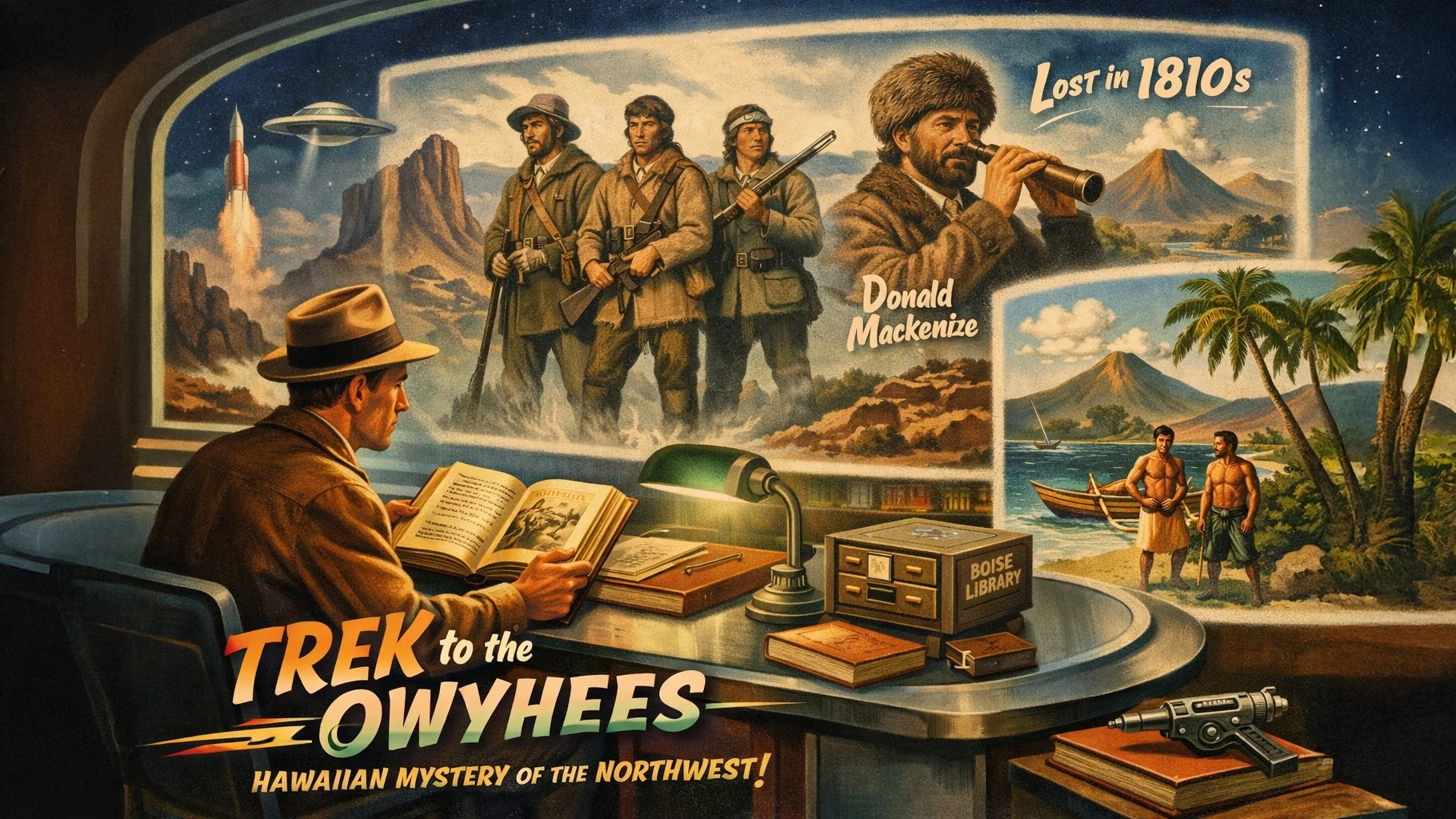
Everywhere I go, I find rabbit holes. Like the Owyhees. It’s one of those loose terms that can mean the river, the mountains, the county, the canyonlands, the reservoir, the desert that all go by that name. I don’t remember when or where, but somebody once told me that Owyhee had something to do with Hawaii. Sounds plausible. But how’d it get over here? Like many questionable stories I’ve heard, I just filed it away. More important things to think about. Probably false. Do something useful with your time.
I looked it up. Donald Mackenzie, a renowned fur trader from Montreal, was exploring the Northwest of America back in the 1810s. He sent three of his men up ahead to check things out. They never returned. We don’t know their names. What we do know is that they were Owyhees. Which is what they called Hawaiians back in the 1810s. And because they didn’t return, and we don’t know their names, that whole region became known as the Owyhees.
Mackenzie’s grandson, Cecil, who was no slouch (he was a pioneer of the telephone, among other accomplishments), wrote a book called Donald Mackenzie: “King of the Northwest.” There’s a copy at the downtown branch of the Boise Library, trapped behind the reference desk. You can read it, but it can’t leave the library. Off I went to the library. They found the book, and I parked myself ten feet away from one of the regulars, who was coughing up a lung. Just like they used to do in the 1810s.
None of this reading, by the way, is helping me with my job hunt.
I read up to page 45, interrupted by my ordering an actual used copy of the book from Powell’s. And then tracking down a copy of Astoria, a related tome (I could just say “book,” but how often do you get to say “tome?”) by Washington Irving, about the brainchild and financial backer of Mackenzie’s exploration, John Jacob Astor. Oh! So that’s how Astoria got its name. Astoria is up at the Twin Falls branch of the library, also trapped behind the reference desk. That’s about two hours away. Or I can order it from Powell’s for about $25. These books are starting to add up. Think I’ll just drive to Twin Falls. Or watch the Disney version of The Legend of Sleepy Hollow, also by Washington Irving. I saw it once, as a kid, at my cousin Steve’s temple in Pasadena, the one that burned down in the fires last year.
I only made it to page 45 because my eyes were dry and burning, not from the guy coughing up his lung, but from pink eye, probably. Just a guess. They’ve been bugging me a couple of days, but starting to get better. No need to get doctors involved.
The librarian, whose name I do not know, told me when I first got there to bring the book back to her desk when I was done. So I did. I asked if I could put in a bookmark and come back. She consulted with another librarian, a woman named Ronnie, who after saying we could do that said “let me see if I can let you check this out.” It was the only copy in the entire system. They’re shrinking the history collection to focus on Boise rather than the kings of the northwest. Friends of the Library have been selling these classic works with no regard for their importance.
Almost right away, Ronnie said she could check the King out to me, and she did. I was worried about getting out of the library with a book clearly marked REFERENCE, but nobody stopped me. I emailed Powell’s and asked them to cancel my order. Haven’t heard back, but it’s only been a couple of hours.
George Washington checked a book out of the library once, and he never returned it. I’m not saying I would do that, but considering all the trouble I went through, I’d be justified. I doubt anyone would miss it. Or maybe I’ll just read it and take notes, so I can use it in my work. Haven’t decided what to do about Astoria yet. And maybe I’ll join the Organization of American Historians, for the gravitas. I’m no scholar, but being associated with scholars could be beneficial.
I haven’t gotten to the part about Astoria, but from what I could gather in the early pages of King of the Northwest, not everyone was pleased with how Mackenzie left things there. He abandoned or retreated from what is now a beautiful location on the Oregon coast. Maybe too rainy. Or maybe too many locals opposed to his wanting to set up trading posts at the mouth of the Columbia River, which was the whole point of the scheme in the first place. I expect to know more by the end of the book. Cecil made it a point to mention Astoria in as mysterious a way as possible, so of course I’m wondering what the hell that’s all about. Guess we’ll find out later.
The biggest question for me, since we’re exploring rabbit holes, is whether there are any living descendants of Donald Mackenzie. And how to get in touch with them. Cecil’s book was published in 1937. The pages of my copy are fragile. Small fragments have ripped away. Not my fault. And who cares about the Owyhees, whether we’re talking about the region here in Idaho or the ones floating in the South Pacific? I care, even if nobody else does. I can always look for a job tomorrow.
